
Acne Scar Treatment
Live Acne & Scar-Free Confidently
Advanced, physician-led treatments to restore smooth, healthy skin — and your confidence.
Understanding Acne Scars
There is Hope
"I used to think these scars would fade away… that time would heal them, but reality has a different plan." This is what most patients tell me. Many people believed in the promise that the scars of their youth would eventually disappear.
It's frustrating, but let's talk about the science behind these scars in a way we can visualize and understand. The more we know, the less we blame ourselves and the more we understand why some treatments work and some don't.
During acne infection, acne bacteria Cutibacterium acnes invade and wage war beneath the surface. We see cells struggling, collagen breaking down, and the aftermath of this battle etched on the skin's surface. Acne isn't just a fleeting blemish. It's a battle that leaves scars — both seen and unseen.
The scars that acne infection leaves can be hollowed-out craters or raised bumps — telltale signs of the skin's struggle to rebuild itself.
Atrophic scars are hollowed out scars that represent missing skin. These scars look pitted or indented because the skin heals below the normal layer of skin due to a lack of regenerative tissue.
Think of a pothole in the road that isn't filled all the way up — that's what the imbalanced skin of an atrophic scar is like.
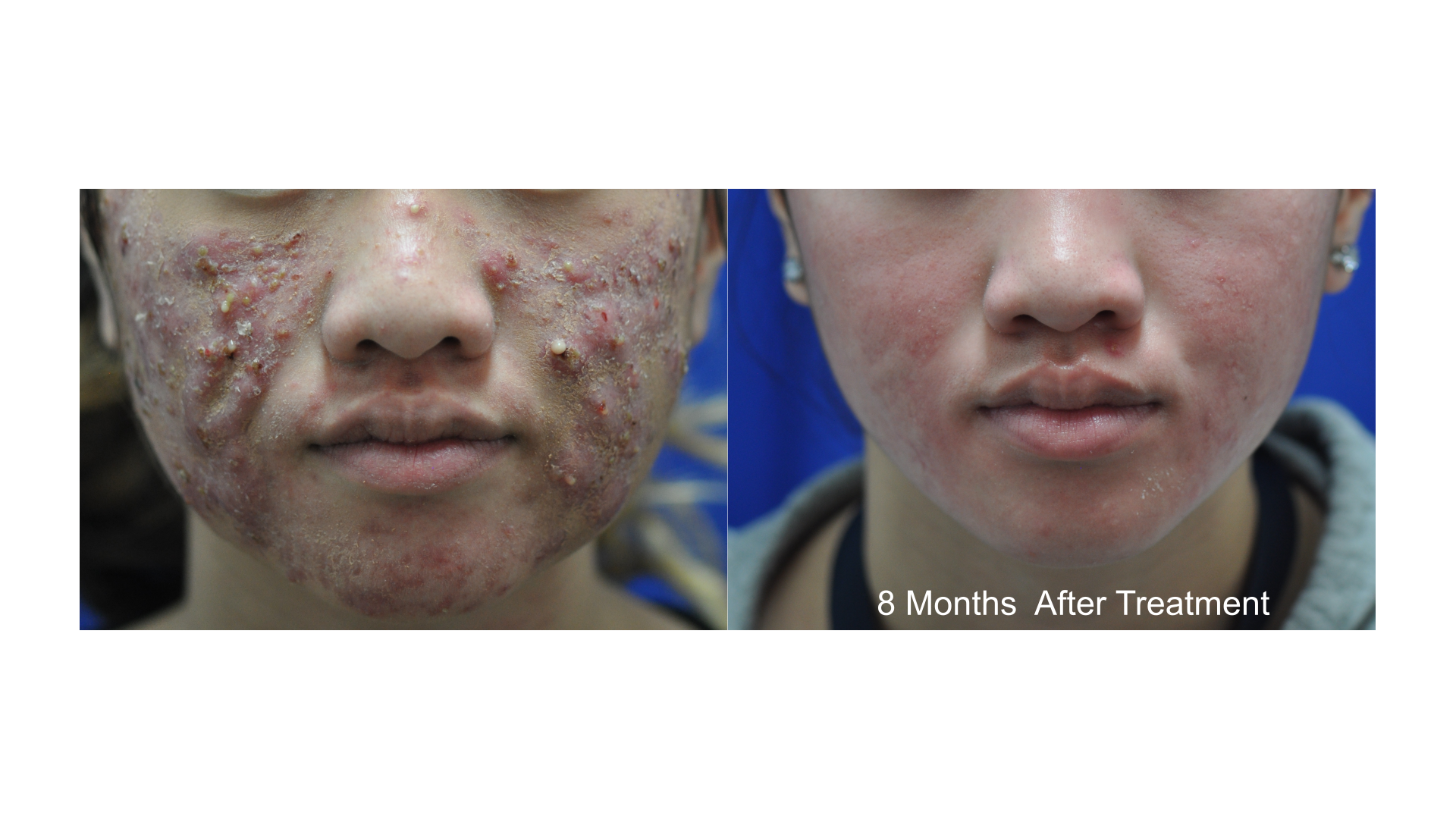
Large cystic active acne with mixed-type scars 90% resolved after 8 months
The earlier you treat active acne and scars during the teen years, the faster and more dramatic the improvement. Younger skin has a powerful repair advantage — teen skin is rich in collagen-producing cells that can fill in the pitted "potholes" left by acne far more effectively than older skin.
Understanding Your Acne Scars
Most acne scarred skin has varying shapes with varying degrees of tissue loss. The types of scars present — whether ice pick, box car or rolling — will require different treatments because no one treatment can address the multiple problems of acne scarring.
Atrophic (Depressed) Scars
Atrophic scars are hollowed out scars that represent missing skin. These scars look pitted or indented because the skin heals below the normal layer of skin due to a lack of regenerative tissue. Think of a pothole in the road that isn't filled all the way up — that's what the imbalanced skin of an atrophic scar is like.
Hypertrophic Scars
Hypertrophic scars are raised, firm scars formed from excess abnormal collagen production during healing. Our skin fights hard against acne infection. When it's fighting really hard, hypertrophic scars occur, determined to heal at any cost, plugging the skin defect more than it should. As opposed to atrophic scars, the skin loses steam in the fight, the repair is lacking, leaving hollowed out scars.
If your skin can fight this hard, so can you. There are so many advanced treatments available now to smoothen the skin. But you need to be realistic in your expectations.
It takes time to grind down the mountains (hypertrophic scars) and to fill up the valleys (atrophic scars).
Real Results
Combination Treatment of Scars
The objective of acne scar treatment is to typically downgrade the severity of scars. For example, the aim might be to reduce scars from Grade 4 to Grade 3. Consequently, it's essential to understand that acne scar treatment isn't a one-time solution. Multiple sessions involving a combination of treatments are usually necessary to achieve the desired results.
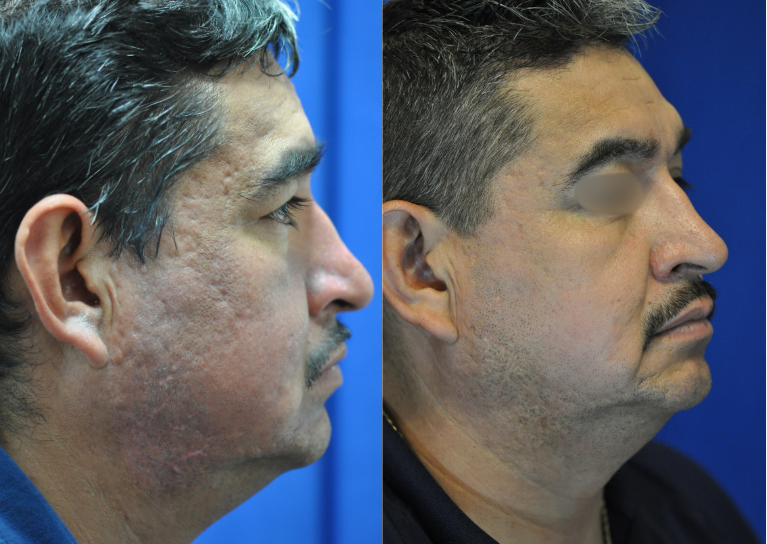
The scars below are Grade 4 scars — considered to be the worst of scars. With the right combination of treatments, it is possible to downgrade it to Grade 3 or 2.
How do you fill a "pothole" in the skin? How do you loosen up the scars that are tethered to the deeper layer? How do you sand down the roughs?
To effectively treat them, a combination of approaches that complement one another is often necessary.
No one treatment can address the multiple problems of acne scarring. A combination approach is essential.
Our Approach
Our Treatment Methods
To effectively treat acne scars, a combination of approaches that complement one another is often necessary.
TCA CROSS
Trichloroacetic chemical reconstruction (TCA CROSS) of scarred skin is very useful for deep, wide-mouth ice pick scars. A strong acid concentration is dabbed into the mouth of the ice pick scars, instantly collapsing the scar walls with the goal of minimizing the scars' depth.
Subcision
This is a lifting procedure that attempts to draw the base of a deep scar upward towards the surface, making the skin less wavy-looking. This procedure is a must to improve rolling scars. Subcision involves a special tool to cut across scar bands that pull the skin inwards. Lasers don't have the ability to release the tethering but once the tethering is released, lasers can work more effectively.
Microtissue Coring
This method pulls out deeply bound scars when subcision isn't sufficient.
Ablative Laser Resurfacing
Resurfacing procedures remove layers of skin from the top down. Injury to the dermis by resurfacing procedures cause dermal remodeling and neocollagenesis. There are two methods of ablative laser resurfacing: the Full Ablative Method, which treats the whole surface area of the skin — peeling away multiple layers of scarred skin, similar to peeling layers off an onion; and the Fractional Ablative Method, which removes cylindrical columns of skin, creating thousands of tiny holes in the scarred skin. The untreated skin between plays a crucial role in healing. Because of this, the fractional ablative method tends to heal faster than the full ablative method.
Laser Treatment Methods
Full Ablative Method
In this method, the laser treats the whole surface area of the skin. The laser peels away multiple layers of scarred skin, similar to peeling layers off an onion. It's a thorough and aggressive treatment.
Fractional Ablative Method
The laser removes cylindrical columns of skin. This approach involves the laser creating thousands of tiny holes in the scarred skin. The dots represent the treated areas, while the spaces in between are left untreated. This untreated skin plays a crucial role in the healing process. Because of this, the fractional ablative method tends to heal faster than the full ablative method. In summary, full ablative mode removes layers of skin, while fractional mode drills tiny holes, with untreated skin aiding in faster healing. Both approaches have their advantages and are effective for different skin concerns, but the choice depends on the specific goals and tolerance for downtime.
When it comes to treating acne scars vs. wrinkles, ablative laser resurfacing is a comprehensive but lengthy and invasive procedure. It can yield remarkable results. However, recovery from this combined procedure may take up to 14 days due to potential swelling and bruising. Fortunately, we now have the technology to dramatically reduce downtime with namely stem cells, PRP, carboxytherapy, exosomes and GlacialRx.
Laser Treatment Methods
Before & After Results
Click any photo to view it larger
Ready to Start Your Journey?
Schedule a consultation with Dr. Lopez and take the first step toward clearer, smoother skin.
Medical Disclaimer: The information on this page is for educational purposes only and does not constitute medical advice. Results vary by individual — no specific outcome is guaranteed. All treatments are performed by or under the supervision of Cynthia M. Lopez, M.D. Before/after photos are of actual patients and are used with consent. Individual results may vary. This website is not intended to diagnose, treat, cure, or prevent any medical condition. Please consult Dr. Lopez directly to determine whether a treatment is appropriate for you.